1. Project Overview
- The designed water production capacity of the mobile integrated equipment set is 3,000 m³/day, and it can be installed in phases according to actual water demand.
- Water source selection: The selected water source type is groundwater (deep confined water), capable of providing long-term, stable water supply with a capacity of 3,000 m³/day.
- Raw water quality: Refer to the water quality test report provided by the owner
- Water quality: meets local drinking water standards
- The construction objectives include enhancing water supply capacity, improving water quality standards, and ensuring supply stability.
2. Basic Data
- The basic data materials used in the project design include:
- Water Quality Monitoring Report (including results of both conventional and non-conventional indicators)
- Population size, water consumption quotas, and forecasts (short-term, medium-term, long-term) for the service area
- Meteorological, hydrological, geological, and topographic data of the project site
- Distribution and connection conditions of existing water supply facilities and pipelines in the surrounding area
3. Process Flow
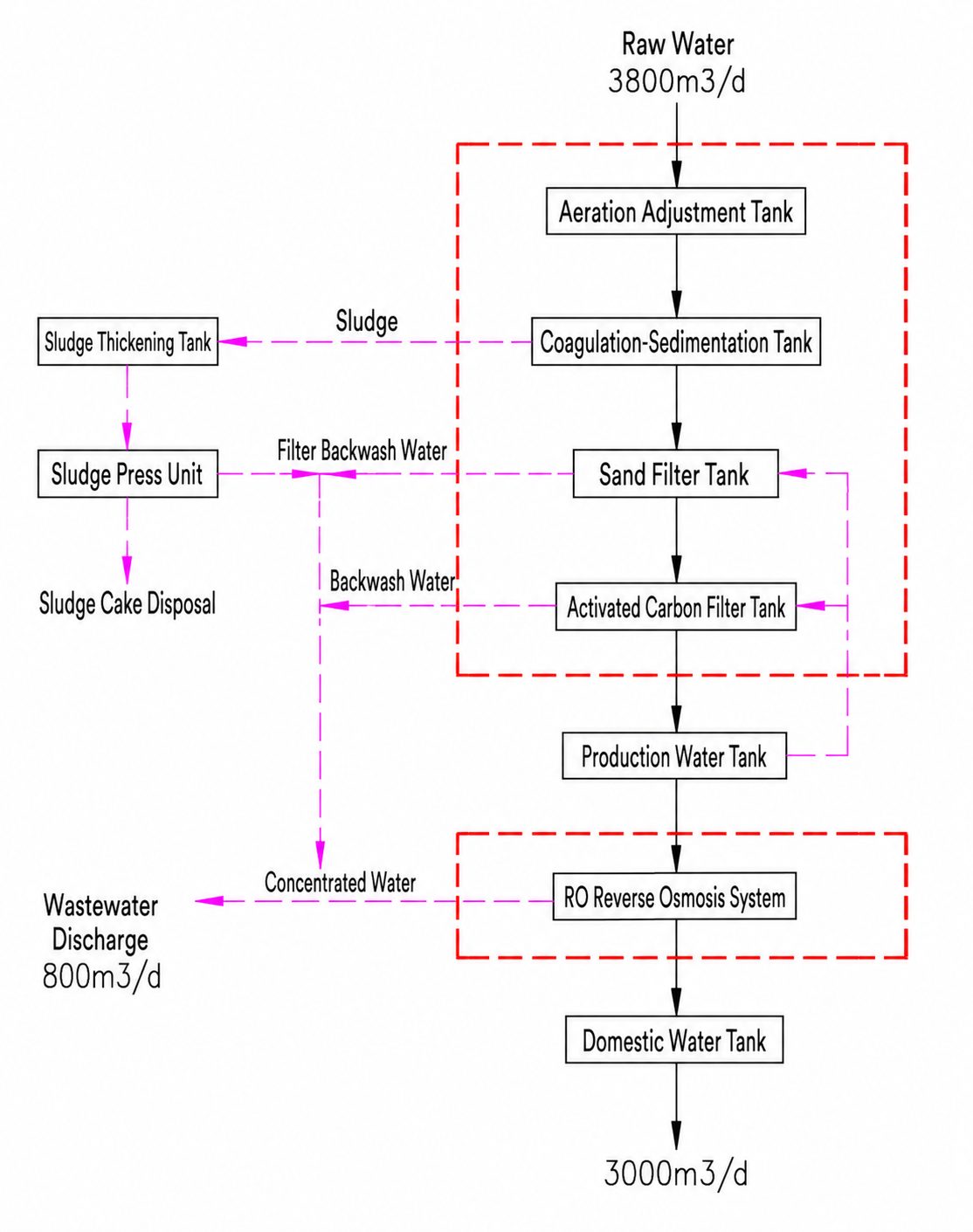
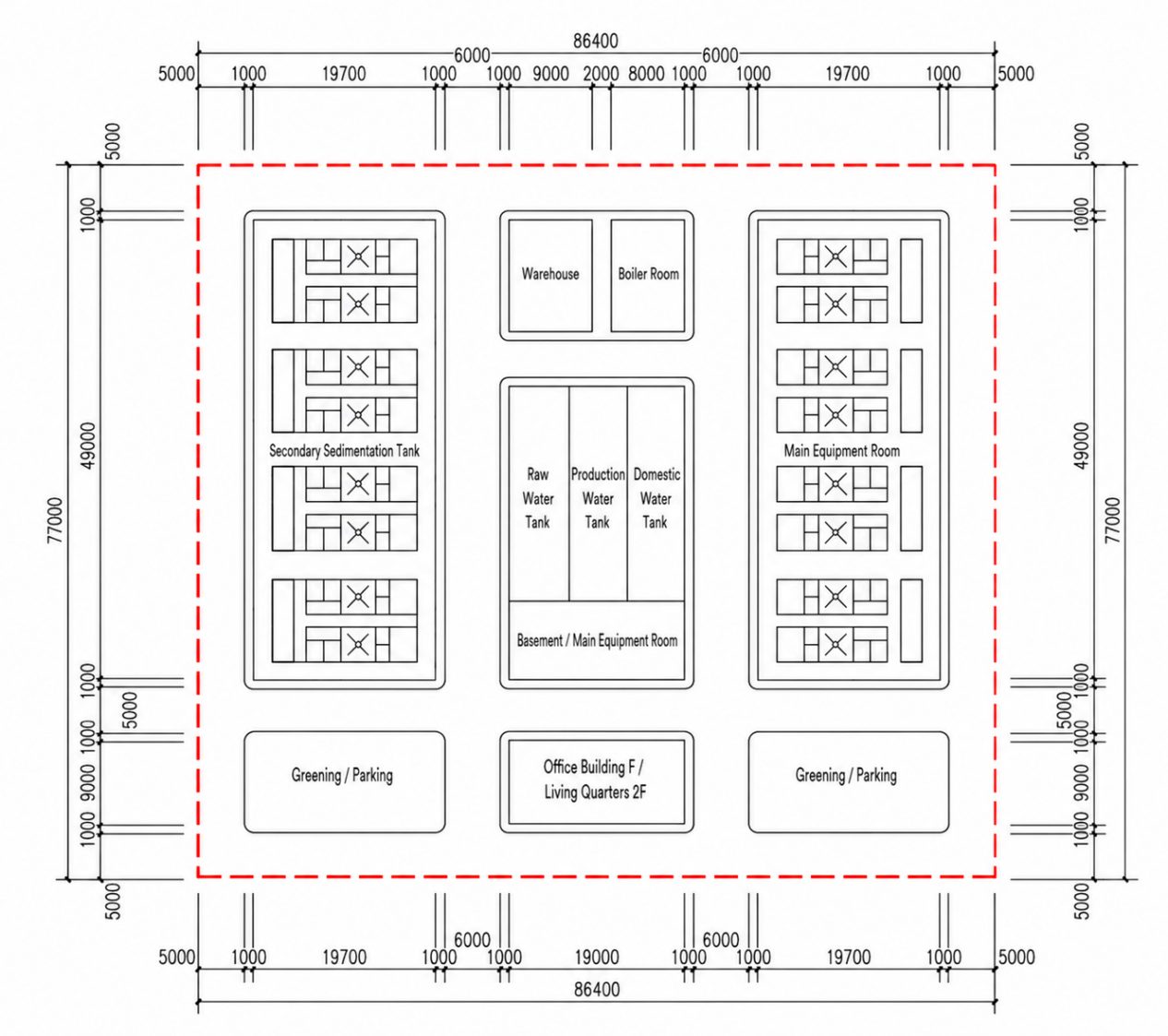
Note: The red dashed line represents the modular integrated equipment, which can be deployed in phases based on water demand.
4. Description
According to the water quality test report provided by the owner, the groundwater source exhibits severely poor quality: iron, manganese, and phosphate ion concentrations all exceed standards by several times; additionally, parameters such as color, turbidity, odor, and conductivity significantly surpass drinking water requirements. Therefore, the core treatment process is determined as follows:
Underground water intake → Aeration and oxidation → Floculation and sedimentation → Iron and manganese removal filter → Activated carbon filter → Reverse osmosis (RO) unit → Sodium hypochlorite disinfection → Clear water tank → Pressure pump room → Water supply network.
This groundwater treatment process is designed to meet water quality standards based on existing testing data, following the core sequence of “water intake – pretreatment – advanced treatment – disinfection – storage,” with each step seamlessly connected and progressively advancing. The detailed process flow and key functions are as follows:
Underground water extraction: Serving as the source of the entire treatment process, raw water is drawn from groundwater aquifers using specialized extraction equipment to ensure operational stability and maintain the initial water quality, thereby providing a qualified feedwater source for subsequent treatment stages.
Aerated oxidation: The extracted groundwater is introduced into an aeration tank, where air is introduced into the water. This process serves two purposes: first, it oxidizes and decomposes reducing substances in the raw water (such as ferrous ions and low-valent manganese compounds) into easily precipitable high-valent oxides; second, it removes dissolved gases (e.g., hydrogen sulfide) from the water, thereby improving its sensory properties.
Filtration and sedimentation: After aeration and oxidation, the water flow enters the filtration and sedimentation tank. PH adjusters and flocculants (such as polyaluminum chloride or polyacrylamide) are added to the water. Through agitation, these flocculants fully contact impurities and oxidation-generated precipitates in the water, forming large flocs (floc florets). Under gravity, the flocs slowly settle, achieving solid-liquid separation and effectively removing suspended impurities and certain colloidal particles from the water.
Iron and manganese removal filter tank: The settled water is pressurized into a dedicated iron and manganese removal filter tank filled with specialized filtration media (e.g., natural manganese sand) to further retain and adsorb residual iron and manganese oxides as well as fine suspended impurities, significantly reducing the levels of iron and manganese ions in the water and ensuring that the effluent meets relevant standards for iron and manganese content.
Activated carbon filter cartridge: Leveraging the high specific surface area and strong adsorption capacity of activated carbon, it removes organic compounds, colorants, odor-causing substances, and residual trace pollutants (such as certain pesticide residues and disinfection byproduct precursors) from water, thereby further enhancing water purity and sensory quality.
RO System (Reverse Osmosis System): As the core component of advanced water treatment, it utilizes the selective permeability of reverse osmosis membranes to allow water molecules to pass through under high pressure while retaining dissolved salts, heavy metal ions, bacteria, viruses, and other contaminants. This process achieves deep water purification, significantly reduces water conductivity, and produces purified water meeting stringent quality standards.
Sodium hypochlorite disinfection: After reverse osmosis treatment, the purified water enters the disinfection stage where sodium hypochlorite is added. Its strong oxidizing properties are utilized to disrupt the cellular structures of bacteria, viruses, and other microorganisms, eliminating pathogenic microorganisms in the water and preventing microbial contamination during subsequent storage and transportation, thereby ensuring the hygiene and safety of the treated water.
Water Storage Tank: Disinfected and qualified water is stored in the water storage tank. This serves two purposes: first, it regulates water volume to balance flow disparities between water intake, treatment, and consumption; second, it ensures sufficient contact time for disinfectants to maintain stable efficacy. The treated water is ultimately delivered to end-users via the water distribution network.
Through the coordinated interaction of all process stages, this entire treatment workflow effectively removes various pollutants from groundwater, producing high-quality treated water that meets usage requirements and is suitable for diverse groundwater treatment applications, including domestic drinking water and industrial production water needs.
5. Layout Design